
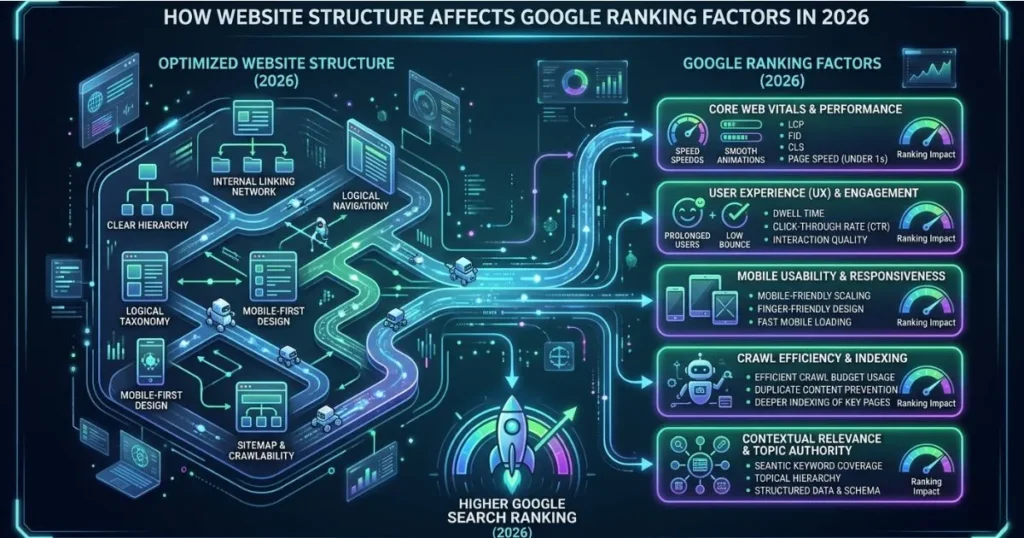
How Website Structure Affects Google Ranking Factors in 2026
In 2026, SEO is no longer just about keywords and backlinks. The digital landscape has evolved dramatically, and Google Ranking Factors now consider website structure, user experience, and technical performance as core elements. Even if your content is excell ent, a poorly organized website can prevent it from ranking well.
Website structure is the backbone of your website. Itdetermines how pages connect, how users navigate, and how search engines understand your content. A clear, organized structure ensures Google crawler scan identify important pages, distribute authority, and index content efficiently. Without it, your website risks weak performance across critical Google Ranking Factors.
Moreover, Page Speed Optimization has become a non-negotiable component of ranking success. A slow website damages user experience, increases bounce rates, and reduces the effectiveness of other SEO efforts. Google now evaluates both technical and behavioral metrics, making speed and structure inseparable elements in 2026
The Connection Between Website Structure and Google Ranking Factors
Website structure directly influences severa l key Google Ranking Factors. User engagement, bounce rate, crawlability, internal linking, and authority flow are all affected by how a site is organised.
When users find information easily, they stay longer and explore more pages. This increases session duration, reduces bounce rate, and sends positive signals to Google. On the other hand, confusing navigation or poorly linked pages frustrate users, causing them to exit quickly. Such behavior negatively impacts Google Ranking Factors.
A strong structure also allows internal link equity to flow properly. Links from the homepage to category pages, subcategories, and content pages help Google understand relationships be tween topics. This strengthens relevance signals, which are now a vital part of ranking algorithms in 2026
Logical Hierarchy and Its SEO Impact.
Every high-ranking website follows a logical hierarchy. Typically, it looks like this
Homepage → Category Pages → Subcategories → IIndividualPages
This pyramid model supports crawlability and allows link equity to flow naturally. Google ranking factors favor websites where content hierarchy is clear and accessible.
If important pages are buried deep with internal links, they might not get indexed efficiently. This weakens their potential to rank. Conversely, a clean hierarchy improves user navi gation, engagement, and overall SEO performance.
Logical hierarchies also make content discoverable. Users can navigate smoothly from general topics to detailed information. Such behavior is increasingly recognized by Google Ranking Factors as a positive signal.
Internal Linking: The Backbone of Web site Structure
Internal linking is one of the most underrated aspects of SEO. It creates a network of connected pages, helping Google understand content relationships.
In 2026, semantic search is stronger than ever. Google evaluates context, topical relevance, and user intent. Well-structured inthe terminal linking directly improves Google Ranking Factors by enhancing topic authority and crawl efficiency.
Strong internal linking also reduces orphan pages, ensures smooth user navigation, and increases session duration. When combined with Page Speed Optimisation, internal links help users move quickly between pages, further boosting engagement metrics
URL Structure and SEO Benefits
Optimised URLs are a small but significant part of the website structure. Descriptive, clean URLs provide context for both users and search engines.
For example:
Bad URL: example.com/page?id =1234
Optimized URL: example.com/seo-website-structure-guide
Prop er URL structure improves indexing, builds user trust, and increases click-through rates. These factors indirectly strengthen Google Ranking Factors, making your website more visible in search results
Mobile-First Structure in 2026
Google now primarily evaluates mobile versions of websites. Mobile-first indexing makes responsive design and structured mobile navigation crucial.
Poor mobile structure — overlapping buttons, broken menus, or slow-loading pages — negatively affects Google Ranking Factors. Users expect fast, easy-to-use websites. If they face difficulty, bounce rates increase, signaling low engagement to Google.
Combining mobile-first design with Page Speed Optimization ensures seamless experiences, which are now essential for high rankings
Page Speed Optimization: A Critical Google Ranking Factor
Page speed is no longer just a technical enhance ment. It has become a primary Google Ranking Factor. Google’s Core Website tals — Largest Contentful Paint (LCP), I nterac tion to Next Paint (INP), and Cumulative Layout Shift (CLS) — evaluate page performa nce and stability.
A slow website results in poor user experience, reduced engagement, and lower rankings. Effective Page Speed Optimisation includes
- Image compression and next-gen formats
- Lazy loading for media
- Code minification for HTML, CSS, and JavaScript
- Browser caching
- Content Delivery Networks (CDNs)
- Optimise the server response time
Websites implementing these strategies not only improve technical performance but also enhance us er behavior si gnals, positively influencing Google Ranking Factors
Content Silos and Topical Authority
In 2026, topical authority is one of the most powerful Google ranking factors. Content silos help structure your website into focused clusters of related topics.
For example:
Main Topic: Website Structure
→ Internal Linking
→ URL Optimization
→ Page Speed Optimisation
Content silos strengthen internal linking, clarify hierarchy, and signal expertise to search engines. Eachsilo, when optimized for speed and usability, improves both crawl efficiency and engagement metrics.
Crawlability, Index, and Technical Stability
Google cannot rank pages; it cannot crawl. Website structure directly affects crawl budget and indexing efficiency.
- Key technical elements include:
- Clear XML sitemaps
- Correct robots.txt configuration
- Canonical tags to avoid duplicates
- Secure HTTPS hosting
- No broken links or redirect chains
These factors are critical Google Ranking Factors. Combined with Page Speed Optimization, technical stability ensures your site performs at its maximum SEO potential.
User Experience and Behaviour Signals
Google evaluates behavioural metrics such as’:
- Bounce rate
- Time on site
- Pages persession
- Scroll depth
All of these are influenced by we bsite structure. Clean navigation, logical internal linking, and fast-loading pages increase engagement and positively impact Google Ranking Factors.
Structured Data and Enhanced SEO
Structured data markup, like sche ma, helps Google understand content context more accurately. While not a direct ranking factor, it enhances visibility, click-through rates, and rich results, directly strengthening Google Ranking Factors
The Strategic Advantage of Technical SEO
In 2026, successful websites balance structure, internal linking, mobile optimization, page speed, and technical stability. Goto Google rewards sites that combine technical precision with excellent user experience.
Ignoring website structure or page speed optimization can limit visibility, even with excellent content. Structurally optimized websites align with modern Google Ranking Factors and have a clear advantage in competitive markets.
Final Thoughts
Website structure is the backbone of SEO in 2026. Google Ranking Factors now assess hierarchy, internal linking, mobile usability, technical stability, user behavior, and speed.
Fast-loading, structured, and mobile -optimized websites receive strong signals for ranking. Page Speed Optimisation enhances engagement, reduces bounce rates, and strengthens all other structural SEO elements